
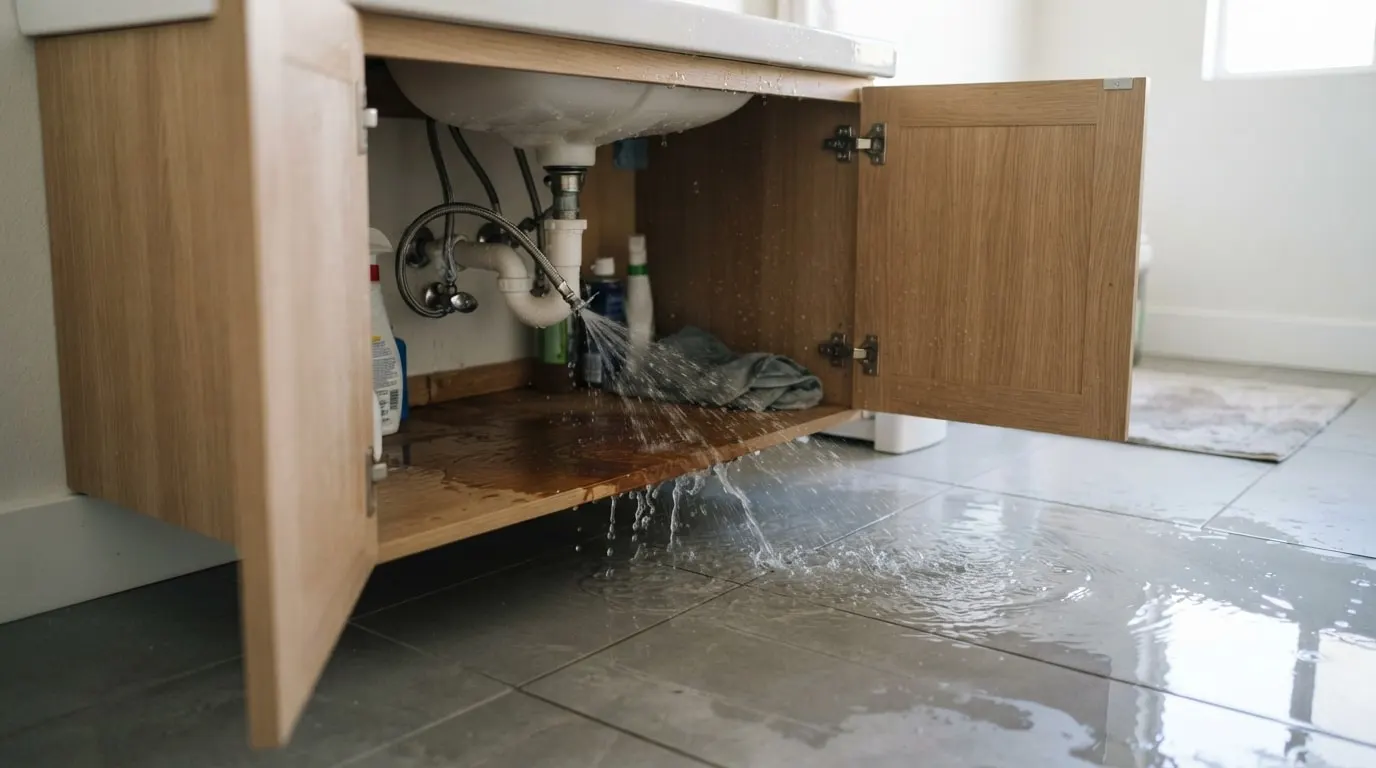
A burst line in a slab-floor house
Most Los Angeles houses sit on a concrete slab, so a split supply line has nowhere to drain. The water spreads sideways under laminate, tile and carpet pad and starts climbing the drywall from the bottom plate up. Los Angeles Water Damage Cleanup answers around the clock, and a licensed, insured restoration crew handles the burst pipe cleanup: extraction, moisture readings along every wall the water touched, and drying until the numbers say it’s done.
Pipes here fail from age, corrosion, worn hoses and high water pressure. What failed tells the crew where the water went, and the sections below take them one at a time.
Is a burst pipe an emergency?
Yes. A supply line is under pressure the whole time, so it keeps flowing until someone closes a valve. A drain leak only runs while a fixture is in use, but a supply leak runs all night. The faster the water is off and extraction starts, the less drywall and flooring has to come out.
Supply lines: toilet, sink, washer and fridge
A lot of these jobs start at the short flexible line between a shutoff valve and a fixture, which gives little warning before it splits.
An older claims study by the Insurance Institute for Business and Home Safety (IBHS) looked at thousands of interior water losses, so read its figures as a pattern rather than a current count. It tied 78 percent of toilet incidents to faulty supply lines, toilet flanges, fill valve assemblies or overflows. A burst supply hose caused half of all washing machine incidents, and the ice maker supply hose caused 73 percent of refrigerator losses.
Water damage from a toilet leak
A burst toilet supply line sprays at full pressure until the stop valve under the tank is closed. A failed fill valve overflows the tank instead, and a worn wax ring leaks slowly out of sight under the base. Each one soaks a different part of the bathroom. Supply line water hits the wall and the vanity side; the wax ring wets the subfloor right under the toilet and, in a two-story house, the ceiling below.
Washing machine hoses
Washer hoses carry hot and cold water at full house pressure. Washing machine makers recommend replacing them every five years, and IBHS recommends braided stainless steel over the black rubber hoses that often come in the box. A burst hose in a hall closet or a garage laundry can run for hours if nobody’s home, and the water follows the slab into the next rooms.
Under the kitchen or bathroom sink
The braided lines under a sink and the compression nut on the angle stop are common failure points. A slow drip here rots the cabinet floor before anyone sees it. A burst line fills the cabinet and runs out under the toe kick. What happens to the cabinet box and the flooring under it is on the floors and walls page.
Refrigerator and ice maker lines
The ice maker line is thin, and it gets kinked against the wall or caught under a wheel when the fridge is pulled out and pushed back. IBHS advises checking it every six months and upgrading to a stainless line. A leak there can run under the fridge and into the flooring for days before anyone notices, so hardwood and laminate near the kitchen often read wet farther out than they look.
Pinhole leaks in old copper
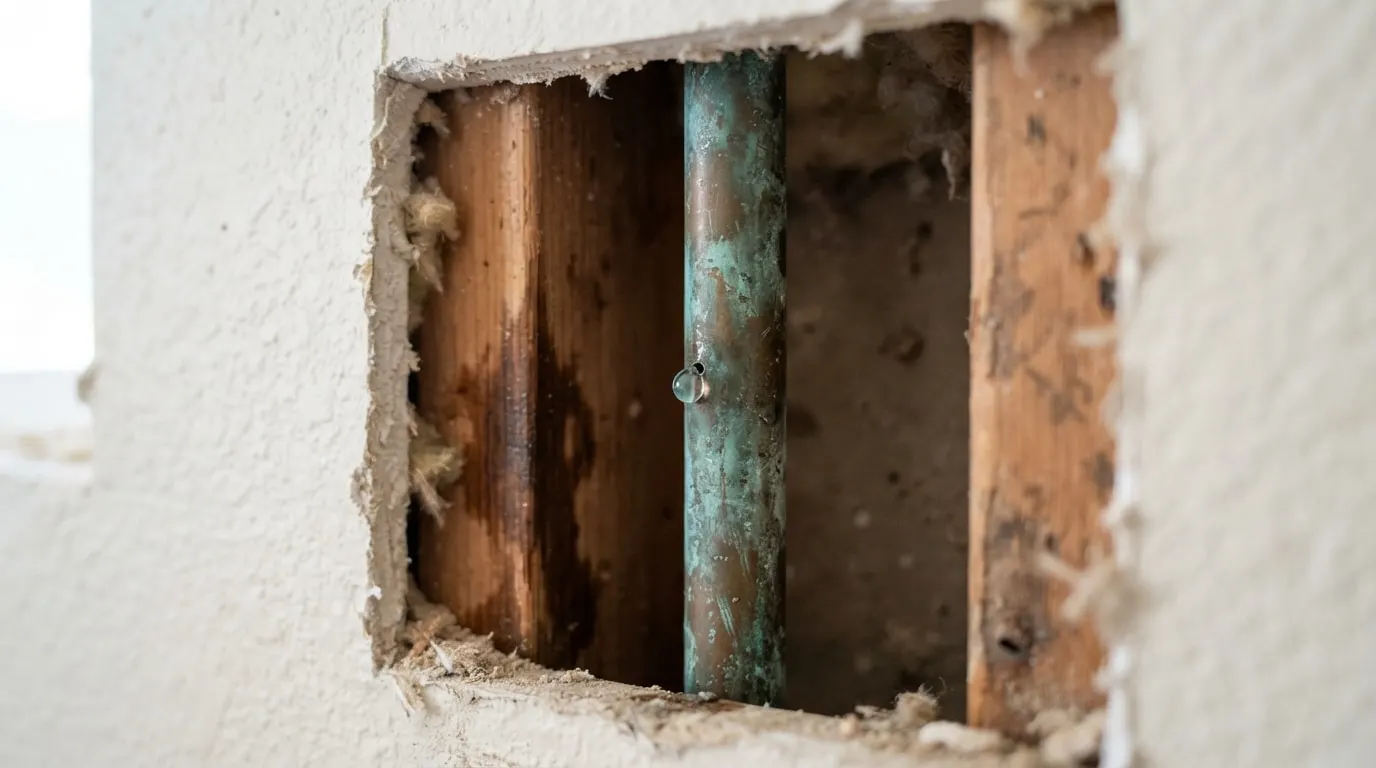
A pinhole leak is the last stage of pitting corrosion, which starts on the inside wall of a copper pipe and eats outward in a small spot while the rest of the pipe looks fine. A technical note written for builders says researchers haven’t pinned down one cause; water chemistry, workmanship and temperature all get blamed. The same note says the real worry for owners is that one pinhole is often followed by another.
The leak itself is a fine spray or a steady weep, usually inside a wall or ceiling where nobody sees it. It shows up as a stain, a bubbled patch of paint, a warm or damp spot on the floor, or a water bill that jumps. When the copper runs through the attic, the first sign is often on the ceiling below it. When the line is buried in the slab, it’s a different job with its own drying problem, covered on the slab leak page.
Galvanized pipe failure
Galvanized steel water pipe rusts from the inside, and that corrosion is hard to detect from outside the pipe, as InterNACHI points out. The usual warnings are brown or rusty water when a tap first opens, pressure that drops at one fixture and a leak at a threaded fitting. One failed joint is a good reason to have the rest of that run looked at while the wall is open.
The cleanup side doesn’t change much between copper and galvanized. What does change is how long the leak ran. A weeping fitting that soaked the wall for weeks leaves wetter framing, more swollen baseboard and a higher chance of mold than a clean break that got shut off in ten minutes.
High water pressure and the 80 psi rule
LADWP says new residential plumbing in the City of Los Angeles needs a pressure regulator wherever main pressure can exceed 80 pounds per square inch. The rule comes from the plumbing code as adopted and enforced by the Department of Building and Safety. Most regulators get set between 50 and 70 psi, and they belong to the property owner, who installs and maintains them.
The catch is the older house. LADWP says homes built before the current code may not have a regulator at all, even where street pressure runs above 80 psi. LADWP also calculates pressure from the ground elevation at each address, so it isn’t the same across the city. Without a working regulator, every hose, supply line and water heater in the house takes the full force. High pressure puts extra strain on supply lines and valves. If a line burst for no obvious reason, ask for the pressure to be checked when the plumbing gets repaired.
Burst pipe in a wall
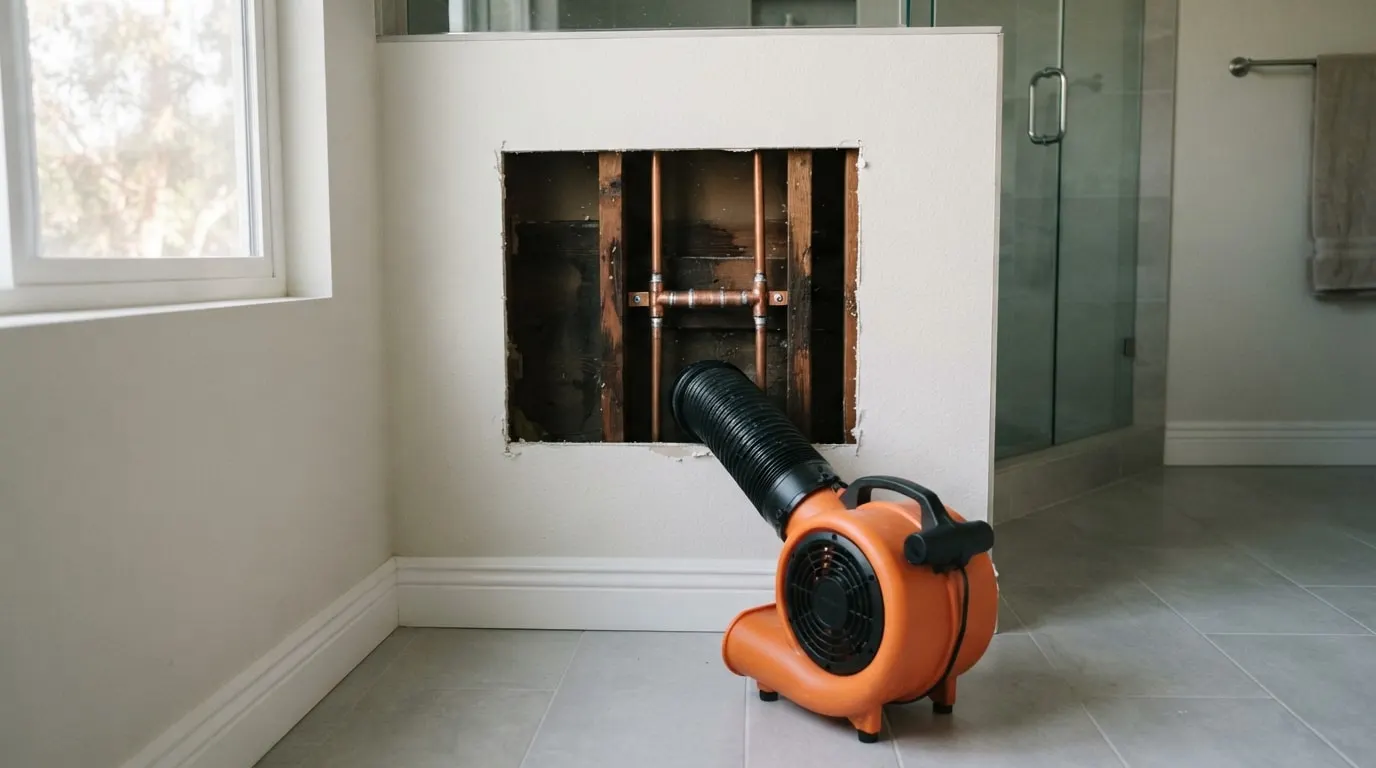
Water from a line inside a wall runs down the inside of the drywall to the bottom plate and spreads out along the floor on both sides. The crew starts with moisture readings along the base of that wall and the walls next to it, on both faces when the other side is a closet or a hallway. The readings decide where the drywall gets cut and how high, so only the wet part comes out.
The baseboards come off first, since they trap water against the bottom of the board. Insulation in exterior walls holds water and usually gets pulled. Then air movers and dehumidifiers run, often with air pushed into the cavity through small holes behind the baseboard line.
Drying after the plumber’s repair
The plumbing repair and the dry-out are two halves of the same job, in a set order. The line gets capped or repaired first, then extraction pulls the standing water. The extraction page covers the first day of that work and how long it runs. After that, the crew opens what needs opening, sets equipment and keeps a drying log with readings each day until every wet spot reads like dry material elsewhere in the house.
Keep the photos from the first hour, the plumber’s notes on what failed and the drying log together. An adjuster looks at how sudden the break was and how long it ran, and those three papers answer both.
Burst pipe questions: walls, toilets and washers
Is the water from a burst pipe clean?
At the moment it leaves a supply line, usually yes. Once it sits in carpet pad, under cabinets or in a wall cavity for a while, it can change category, which changes what gets cleaned and what gets cut out. The restoration page explains how the category is set.
Can the wall be dried without cutting it open?
Sometimes. Painted drywall over a short, clean leak can often dry in place with air pushed into the cavity. Insulated exterior walls, vinyl wallpaper and swollen baseboards usually mean a cut. The floors and walls page covers where that line gets drawn.
The leak is in the unit above me. Is that a burst pipe job or a ceiling job?
Both, and the drying starts at your ceiling. A failed line upstairs runs between the floors before it reaches you, so the crew reads the ceiling and the walls under it. The ceiling leak page covers sagging and what to keep clear of.
Does a pinhole leak count as sudden water damage?
It depends on how long it ran and what the policy says. A spray that started yesterday reads differently to an adjuster than a stain that's been growing for months. The insurance claims page covers sudden versus gradual and what to photograph.