
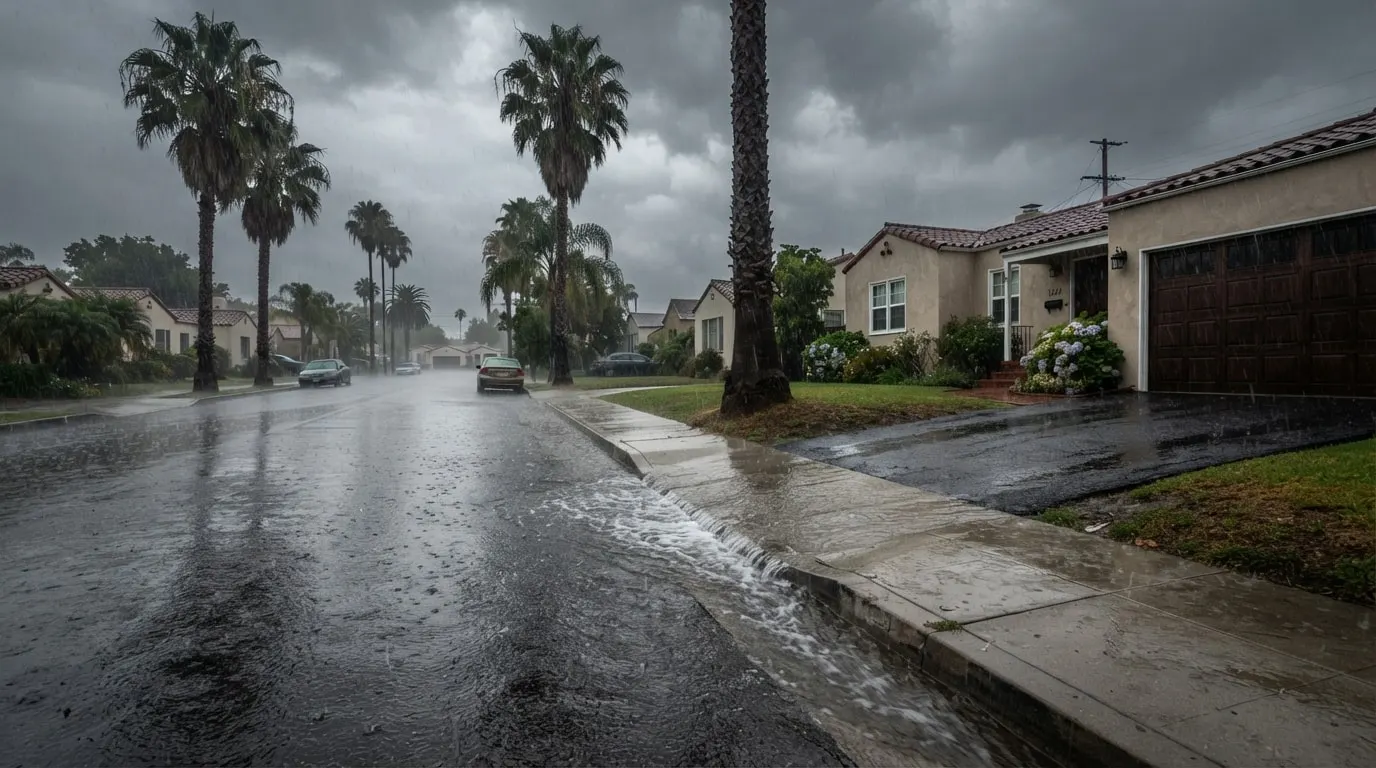
Storm water in a house with no basement
Rain that gets past a door in Los Angeles has nowhere to go down. Most houses here sit on a concrete slab, so storm water spreads across the floor, wicks into the bottom of the drywall and soaks every baseboard it reaches. Los Angeles Water Damage Cleanup answers around the clock, and flood cleanup in Los Angeles starts with a licensed, insured crew pulling that water and mud out before it climbs higher.
The call usually comes in one of three ways. Water is sheeting under the front or patio door. Mud has come down a slope and piled against a back wall. Or the ceiling is dripping because a flat roof can’t drain. Each one is handled differently, and the first questions on the phone are about which one you’ve got.
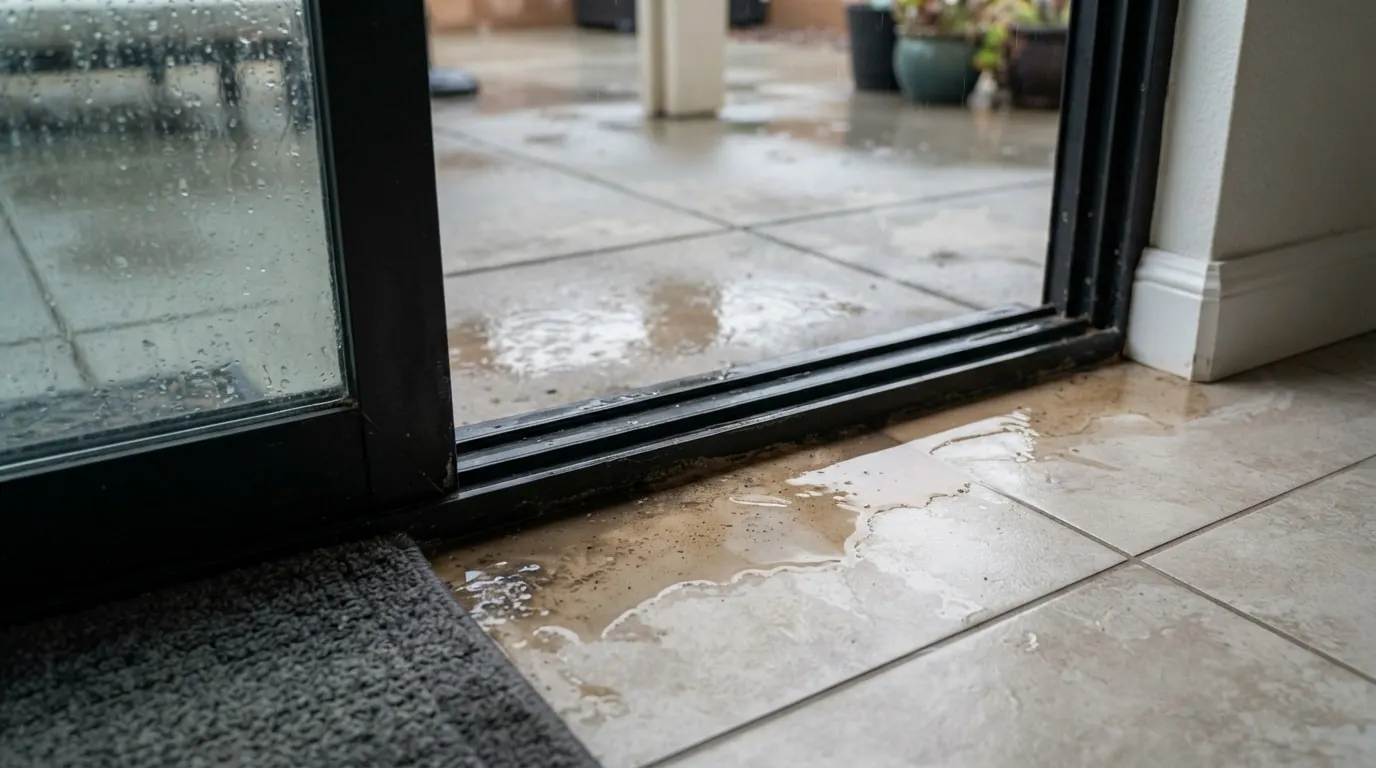
Where the water got in decides the job
Storm water reaches a house from above or from the ground, and the path matters twice: once for how the crew cleans it, and again for which policy looks at it.
| How it got in | How the crew treats it | Policy that usually looks at it |
|---|---|---|
| Under a door or through a wall from the yard or street | Handled as Category 3, since it ran over soil, pavement and whatever was on them | Flood policy |
| Mud or debris flow off a slope | Category 3, with the mud shoveled and hauled out before extraction | Flood policy, since mudflow counts as flood; see the wildfire note below |
| Through a roof, window or vent the wind opened | Judged on inspection; roof rain isn’t automatically Category 3 | Homeowners, where wind or another covered peril opened the roof |
| Up through a toilet or floor drain during the storm | Sewage, always Category 3 | Depends on the cause; see the sewage page |
Category 3 means the crew wears protection, porous material in the water’s path mostly comes out, and everything left gets cleaned before drying starts. The categories themselves and how the crew sets them are explained on the water damage restoration page. If the storm pushed water up a drain, the steps change again, and sewage backup cleanup covers that job.
Atmospheric rivers and a year’s rain in a few storms
Southern California doesn’t get rain spread across the winter. Scripps researchers at the Center for Western Weather and Water Extremes found that, on average, 10 to 40 hours of rainfall bring more than half of a year’s total here. The heaviest of those hours mostly come from atmospheric rivers, long and narrow bands of moisture carried in from the tropics.
So the storm drains, gutters and roof drains that cope all year get overwhelmed in one night. In early February 2024, Los Angeles got 7.03 inches over February 5 and 6, its wettest two days since January 1956, and the National Weather Service logged more than 13 inches in four days at a Bel Air gauge.
More is forecast this winter. On September 21, 2026 the governor declared a state of emergency ahead of what the state calls a likely historic El Niño, and NASA notes that El Niño winters tend to push wetter atmospheric rivers into California.
For the house, a storm like that means water arriving faster than any drain can take it. The first wet spot is usually the lowest door, the garage or the corner of the roof where water ponds.
Mud and debris below the 2025 burn scars
A burned slope sheds water like pavement. LA County Public Works says debris flows can start in and below areas where fire has stripped the vegetation and changed the topsoil, and that those flows carry soil, rocks, brush and trees into neighborhoods. Before the February 2025 storms, the city put evacuation warnings and orders on parts of the Palisades, Mandeville Canyon, Sunset and Hurst burn scars.
When that mud reaches a house, it doesn’t stop at the yard. It piles against the wall that faces the hill, pushes through the lowest door and leaves silt across the floor. The city’s emergency department advises getting mud off building walls fast, because further slippage puts more pressure on the structure.
The wall the mud sat against is where the crew starts reading and cutting. Hillside streets in Sherman Oaks and the slopes above Glendale see the same pattern in heavy rain even without a recent fire.
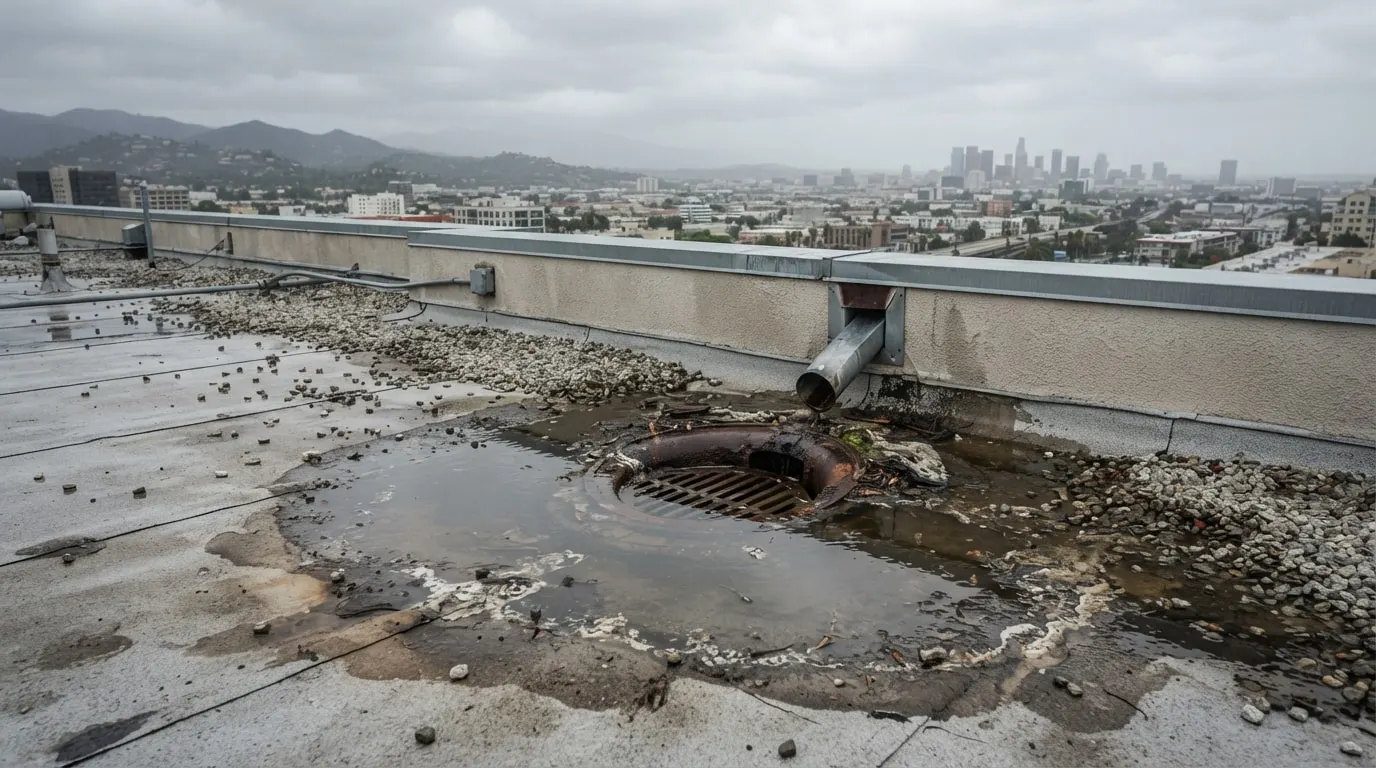
Flat roofs, scuppers and the ceiling below
A flat or low-slope roof doesn’t shed water off its edges. It drains through a few scuppers in the parapet wall or roof drains piped down through the building, and one of those clogged with leaves holds a pool across the roof. In a long storm that water finds a seam, a cracked membrane or a parapet cap and comes through the ceiling.
Roof rain is usually cleaner than ground water, so more of the ceiling and wall can often be dried in place once the crew reads it. A ceiling leak after heavy rain has its own sagging, insulation and attic questions, and the ceiling leak water damage page goes through those. On a storm call, tell us whether the drip started at the edge of the room or the middle. The edge points to the parapet or wall, the middle to a drain or a low spot.
Garages and slab-level doors
Water that gets under a garage door has the whole garage slab to cross before it reaches the door into the house. On the way it soaks boxes, the bottom of the drywall and the base of a garage water heater. Slab-level patio and sliding doors let water straight onto the living room floor, where it runs under laminate and carpet before you see it on top.
On a slab, the crew lifts or pulls back the flooring along the entry wall and reads the concrete and the bottom plate of the wall behind it. What a leak inside a slab looks like is a different problem, covered on the slab leak water damage page. Storm water comes in at the edge and works inward, so the readings start at the door.
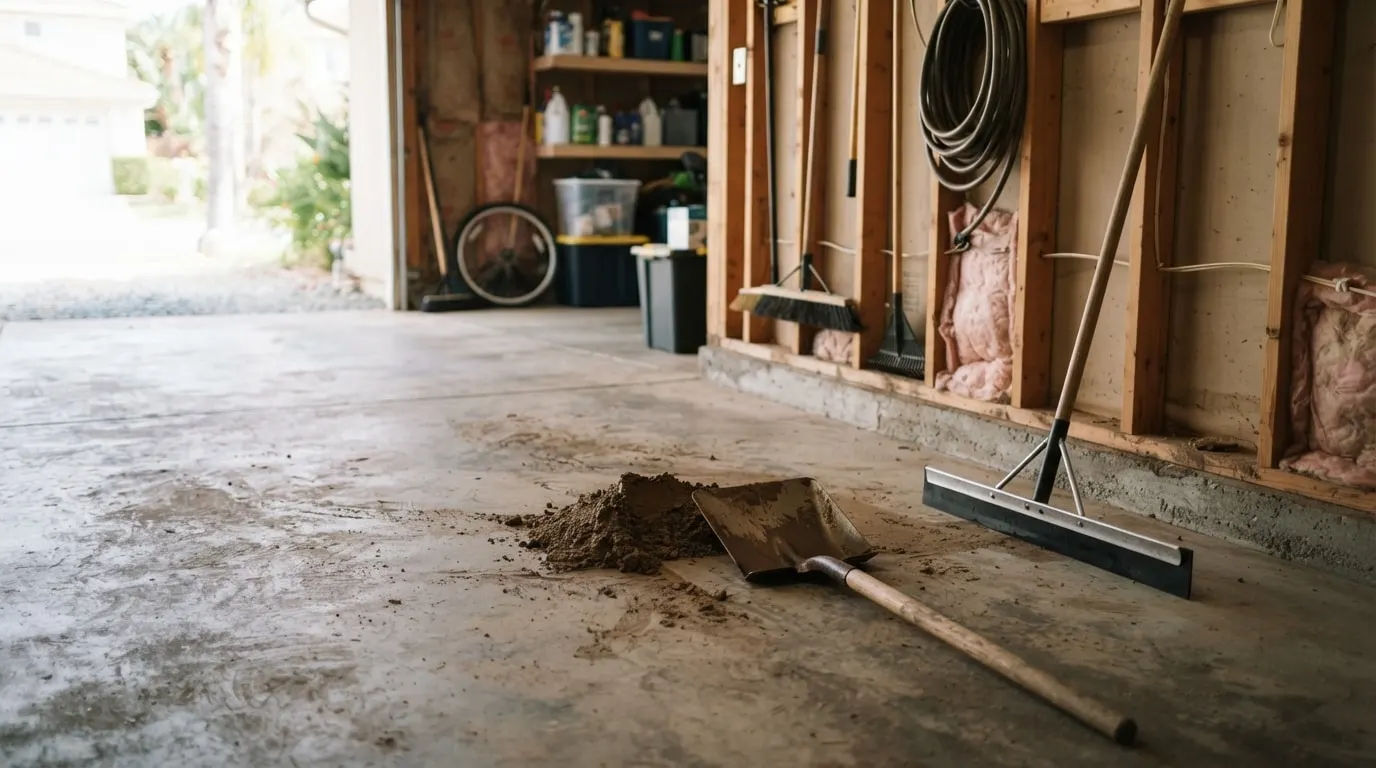
From mud on the floor to a dry slab
A house flooded from rain gets cleaned in a set order, because Category 3 water has to be dealt with before drying:
- Mud and debris out. Shovels and wheelbarrows first, so the extraction gear isn’t pulling silt.
- Extraction. Standing water comes off the slab with truck-mounted or portable units. The first hours are spelled out on the emergency water extraction page.
- Tear-out. Carpet and pad that floodwater soaked come out. Drywall gets a flood cut above the highest wet reading, along with the insulation behind it.
- Clean and treat. The slab, the studs and the bottom plates get cleaned of silt before any drying equipment goes in.
- Dry and read. Air movers and dehumidifiers run while the crew logs readings every day. Hardwood, laminate and cabinets each have their own call on dry-in-place versus replace, and water-damaged floors and walls covers those.
Cleaning before drying is the step that keeps mold from coming back behind new drywall. If a wall was left closed and wet for days before the call, the mold after water damage page covers what changes.
Water damage vs flood damage insurance
Homeowners insurance and flood insurance are two separate policies, and storm water can fall under either one. The California Department of Insurance says homeowners and commercial policies typically exclude flood, mudslide and debris flow. Flood coverage comes from a separate policy, most often through the National Flood Insurance Program, which FEMA runs and private insurers sell.
The NFIP counts it as a flood when water covers two or more acres of normally dry land or two or more properties, one of them yours, from overflowing water, an unusual and rapid buildup or runoff of surface water, or mudflow. Rain running down the street and in under your door during an atmospheric river fits that definition. Rain through a roof the wind tore open does not, and that claim usually goes to the homeowners policy instead.
Homeowners, the FAIR Plan and mud after a wildfire
For hillside homes in California, the answer can shift. The Department of Insurance says the California FAIR Plan doesn’t cover storm-related damage unless a separate difference-in-conditions policy was added. When a wildfire caused the mudflow, the department says a homeowners policy may still cover it under the “efficient proximate cause” rule, because fire is a covered peril.
That’s one more reason to record where the mud came from and what burned above you.
What a flood policy pays for and what it skips
An NFIP policy pays for direct physical flood damage, and building and contents coverage are bought separately, each with its own deductible. Building coverage reaches the structure, built-in appliances, the water heater and permanently installed carpet and cabinets. Contents coverage handles furniture, clothing and electronics.
FloodSmart lists what it leaves out no matter what caused the flood:
- hotel stays and other living costs while the house is being repaired
- landscaping, decks, patios, fences and pools outside the building
- cars
- cash, valuable papers and stock certificates
How to document the claim, and why water claims get denied, are on the water damage insurance claims page.
Photos of the waterline and the way in
On a storm claim, the adjuster’s first question is how the water got inside. A roof opening points to one policy and a door at ground level to another, so the photos need to show the path as well as the damage.
Take them before the crew starts hauling, then let the work go ahead. The moisture map and daily drying log the crew keeps go into the same claim file.
Storm and flood questions after the rain
Can I buy flood insurance now and have it cover this storm?
No. A new flood policy generally takes effect 30 days after purchase, so it won't pay for water that's already inside. The main exception is a policy bought at closing because the lender requires it, which starts right away. Get the water out now and sort out coverage for the rest of the season after.
I rent. Does my landlord's flood policy cover my things?
Usually not. The California Department of Insurance says a tenant's belongings generally aren't covered by the landlord's policy. Your renters policy, or a contents-only flood policy if you have one, is what responds. The building itself, the drywall, the carpet and the cabinets, is the owner's side of the claim.
How long do burned hillsides stay a mud risk?
Years. LA County Public Works says it takes about four to five years for vegetation in a burn area to mostly grow back and about ten to recover fully. Homes below the January 2025 burn scars are still inside that window this winter.
Do I have to clear the mud out of my own yard?
In the City of Los Angeles, yes. The city's emergency department says private owners are responsible for removing debris from their own lots. Inside the house, the crew deals with mud that's against the walls or inside the rooms first, since that's what keeps soaking drywall and framing.