
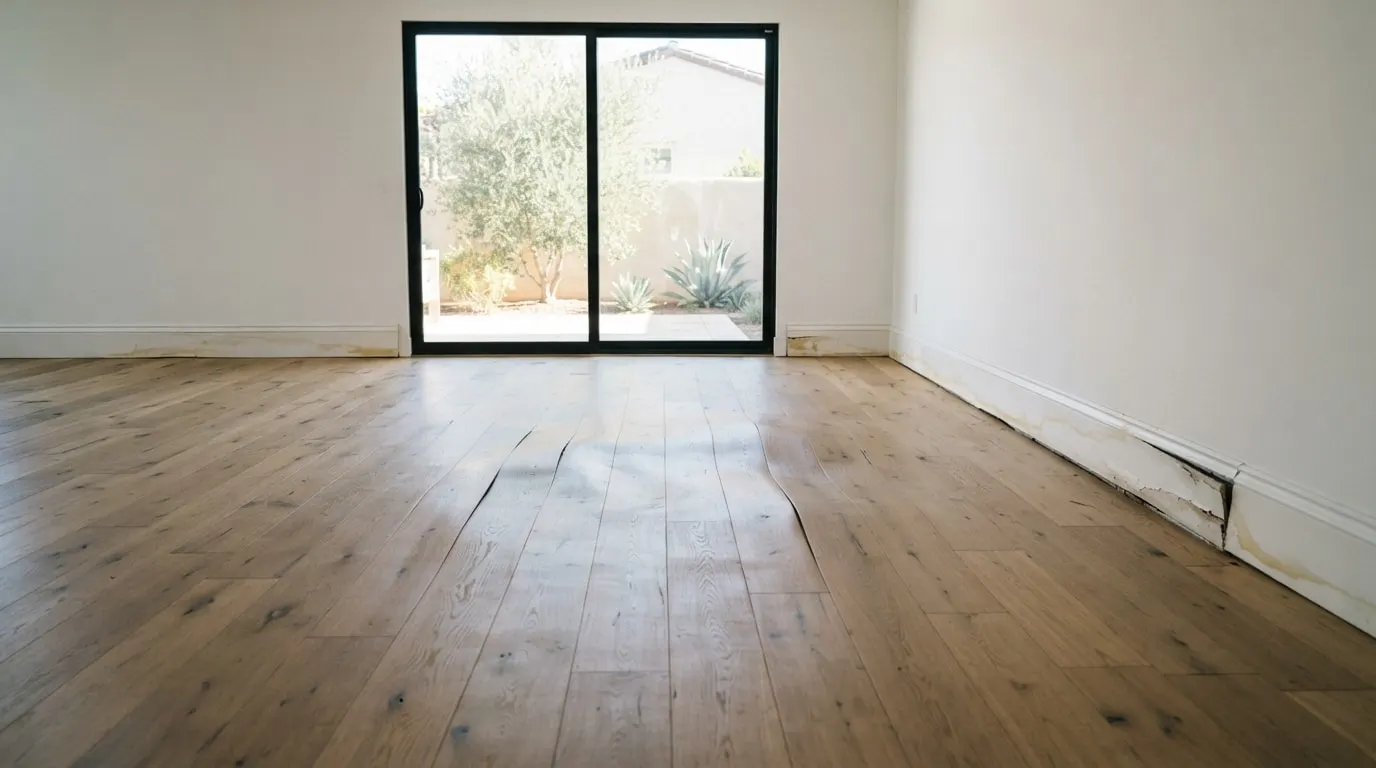
Where floor water goes after a leak
A dishwasher line lets go, a water heater drains across the hall closet, or the supply under the kitchen sink sprays for an hour before anyone’s home. The water you mop up is the easy part. The rest has already slipped between the boards, run under the base cabinets and started wicking up the drywall behind the baseboard.
Los Angeles Water Damage Cleanup takes these calls around the clock and gets a licensed, insured restoration crew out to deal with water damaged hardwood floors, laminate, carpet, baseboards, drywall and cabinets across Los Angeles. The first job on site is a moisture map: the crew lead scans the floor and the base of every wall in the wet rooms and marks where the readings stop. That map, more than how the room looks, decides what dries in place and what gets cut out.
Can water-damaged wood floors be repaired?
Most of the time, yes, if the floor hasn’t buckled and the water’s stopped. The National Wood Flooring Association’s technical lead puts it plainly: with real wood floors nearly everything is repairable, and minor water damage often fades as the floor dries. Look at the boards themselves to see how far along it is.
| What you see | What’s going on in the wood | Usual outcome |
|---|---|---|
| Edges of each board higher than the middle (cupping) | The underside is wetter than the face and has swollen more | Often dries flat once the source is stopped and the moisture comes down |
| Middle of the board higher than the edges (crowning) | Usually a cupped floor that was sanded flat while still wet, then dried | Hard to fix; often means replacing the boards |
| Boards lifting off the subfloor (buckling) | Swelling pushed past what the nails or glue could hold | The buckled area gets replaced |
| Gaps between boards after drying | Boards swelled against each other, got crushed at the edges and shrank back smaller | Filled or replaced, depending on width |
Cupping
Water on a finished floor runs into the seams and soaks into the boards from below. The bottom swells, the face doesn’t, and each board curls up at the edges. A trade test shows how fast it happens: a strip of flooring set on a damp towel shows some cupping in a day or two. Slight to moderate cupping can usually be saved by cutting off the water and drying the wood all the way through. That takes dehumidifiers and air movers, often with some heat, and a box fan for a week won’t get there.
Crowning and buckling
Crowning is the one people cause by hurrying. If a cupped floor gets sanded flat before the wood is dry, the edges shrink down once it finishes drying and the middle of each board ends up high. Buckling is different: the whole board swelled so much it lifted, and once that happens the fasteners or adhesive don’t hold anymore. That section comes out.
Hardwood over a slab or a raised subfloor
LA has both, and they dry differently. In the Census Bureau’s 2023 American Housing Survey for the Los Angeles metro, about six in ten single-family homes sit on a slab and about a third on a crawlspace, as the slab leak page explains. Older houses are more likely to have wood floors on joists, and newer houses and many condo buildings sit on concrete. Not sure which you have? Ask on the call. Crawlspace vents low on the outside walls usually mean a raised floor.
Over a raised wood subfloor
The water has somewhere to go: down through the plywood or plank subfloor into the crawlspace. Plywood can swell and delaminate, and swollen OSB loses its grip on the flooring nails. The crew reads the flooring, the subfloor and the framing at several depths, and usually opens the crawlspace for airflow and heat. Wet insulation under the joists comes out so the subfloor can dry.
Glue-down floors on concrete
The slab itself rarely gets hurt by water. The trouble is that adhesive and sealers slow the concrete’s drying, and water held against the glue line can break the adhesive down into a liquid that the wood then soaks up. A glue-down floor on a slab can look fine for a week and then start lifting in patches. Readings have to come from the wood and the concrete, and new flooring only goes down once the slab is within the flooring and adhesive makers’ limits.
Floating floors on concrete
Engineered planks and laminate that click together aren’t fastened down. Water that gets under them sits between the planks, the underlayment and the slab with nowhere to drain, so the floor usually has to come up for the slab to dry. The EPA describes a simple check for bare concrete. A sheet of clear plastic gets taped down for about 16 hours, and moisture on the underside means the slab is still too wet for new flooring. If the water came up through the slab instead of across it, see slab leak water damage for how that dry-out is handled.
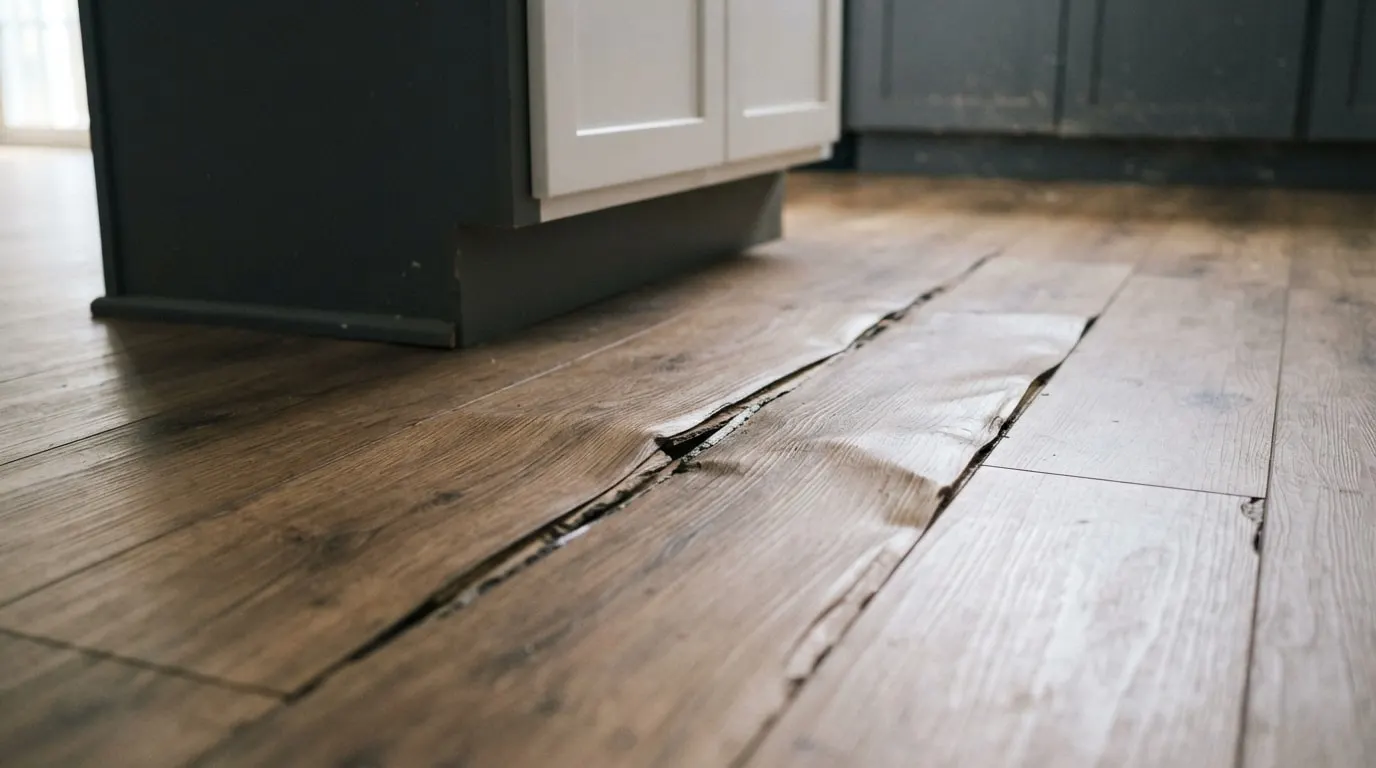
Laminate and engineered planks
Laminate has a fiberboard core, and the core is what fails. One European maker’s floor guide says standing water gets into the core through the edges and causes permanent damage, and the Composite Panel Association says fiberboard and particleboard that swell past their original size don’t fully shrink back when they dry. Laminate planks with puffed or peaked edges get replaced. Planks that only had water on top and read dry can stay.
Engineered hardwood behaves more like solid wood on top and plywood underneath. It cups when it gets wet. Some engineered boards also cup when they dry out too fast, because the wood face shrinks faster than the plywood backer. That’s one more reason the crew dries it on readings, not on a timer.
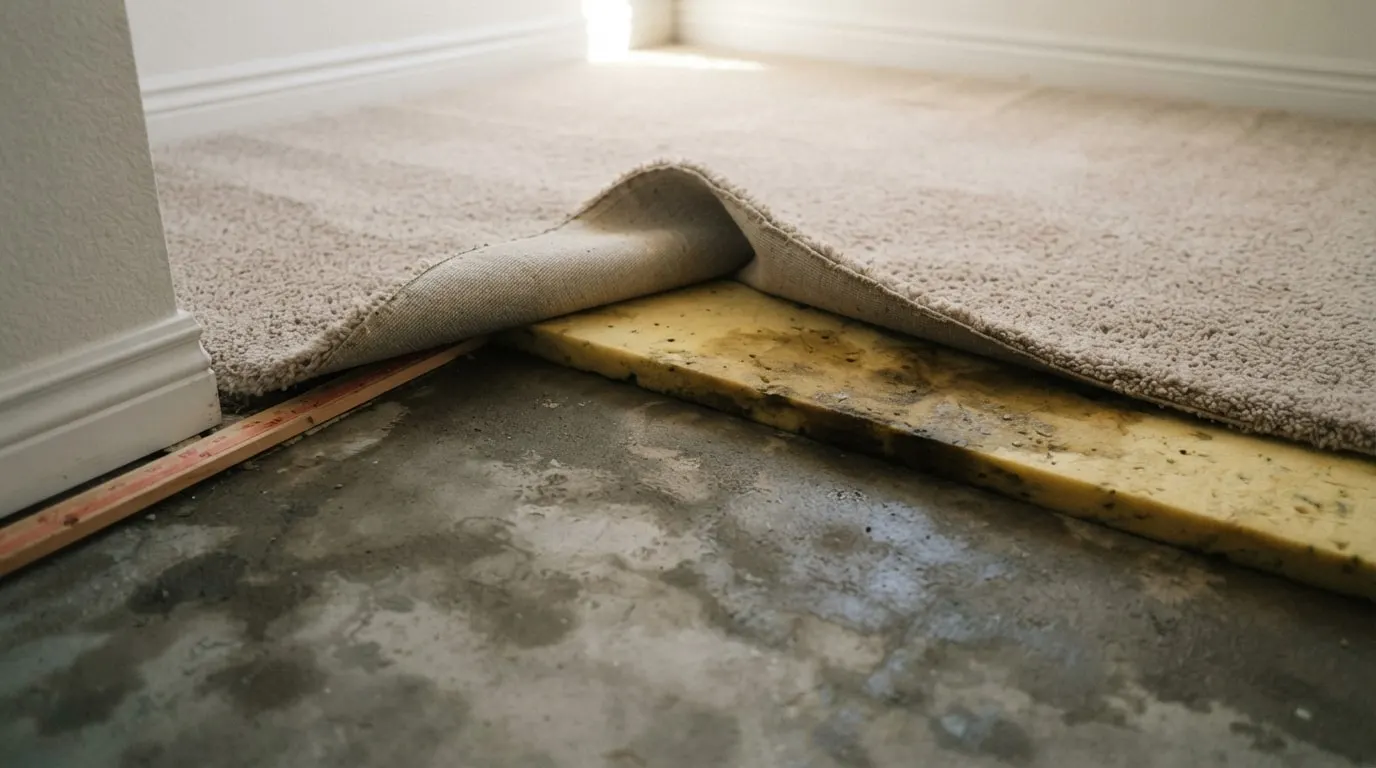
Wet carpet and the pad under it
Carpet soaked by clean water from a supply line can often be saved if it’s dried fast. EPA guidance gives carpet and backing a 24 to 48 hour window, and notes that a wet vac alone won’t dry it. The carpet gets pulled back so the pad and the floor underneath can dry before it’s stretched back in. On a slab, the concrete under the pad has to dry too.
The pad is the weak part. It soaks up far more water than the carpet above it, and FEMA’s flood repair guide lists carpet padding among the things that usually get thrown out after floodwater. Pad soaked by a toilet overflow or a sewer backup comes out no matter what, and cleanup after a sewage backup explains why.
Water damage on baseboards
Baseboards are usually the first thing to show it. They’re nailed at the floor line against the bottom edge of the drywall. On a slab there’s nowhere lower for the water to go, so it wicks straight into the trim. You’ll see paint bubbling at the bottom, caulk lines pulling away, dark staining at the joints, or the board swelling and splitting at a nail.
What happens next depends on what they’re made of:
- Solid wood baseboard can darken or swell a little and often dries back. If it reads dry and the joints close up, it can be cleaned, sanded and reinstalled.
- MDF baseboard, the smooth primed trim sold in long painted lengths, swells at the bottom edge and stays swollen. The Composite Panel Association says swelling in MDF isn’t reversible on drying, and it recommends moisture-resistant MDF for baseboards in slab-on-grade houses for exactly this reason. Swollen MDF base gets replaced.
- Vinyl or rubber cove base doesn’t soak up water but can hide it. It comes off so the wall behind can be read.
Either way, the baseboard along the wet wall comes off early. With it gone, the crew can read the bottom few inches of drywall and the wood sill plate at the base of the wall, and see whether water is sitting inside the cavity. FEMA’s repair guide uses the same approach: pull the base and probe just above the sill plate. A baseboard that’s been pulled, numbered and set aside is also a lot easier to put back than one that’s been left to rot in place.
Should water-damaged drywall be replaced?
Only when it’s swollen, crumbling or the taped joints have opened. EPA guidance says drywall with no obvious swelling and intact seams can be dried in place, with the wall cavity vented. Gypsum board pulls water upward like a sponge, so a wall can read wet well above the line where the water stood.
When it does come out, the crew cuts a straight line along the wall above the highest wet reading. That’s the flood cut. Everything below it gets pulled so the framing and insulation can dry. The height comes off the moisture map, not a fixed number. Cut too low and wet board stays up on the wall. Cut too high and there’s new drywall to hang on a wall that was dry.
Behind the drywall:
- Fiberglass batts that got wet usually come out so the wall can dry, per FEMA’s guide.
- Studs and sill plates stay and get dried. Wood framing that reaches normal moisture doesn’t need replacing.
- Plaster walls in older houses survive water better than drywall but take far longer to dry.
The type of water matters as much as the reading. Drywall soaked by clean supply-line water can be a dry-in-place job. Drywall soaked by toilet or sewer water comes out. How the crew sorts water into categories is laid out under water damage restoration.
How to tell if water damage is in the walls
The signs show up low and late. Look for:
- paint that’s bubbled, peeling or blistered near the floor
- baseboard that’s swollen, split or pulling away from the wall
- drywall that feels soft or gives when you press it
- tan or brown staining that spreads upward from the floor
- a musty smell in one corner or closet
- hardwood or laminate cupping along one wall
Any of those can mean water in the cavity, but none of them tells you how far it’s gone. Meters do. The crew runs a pinless scan across the wall face to find the edges of the wet area, then takes pin readings into the drywall and framing at the worst spots. A wall can read wet with no stain on it at all, behind a shower valve or next to a dishwasher. If the smell’s already there, read mold after water damage for what that changes.
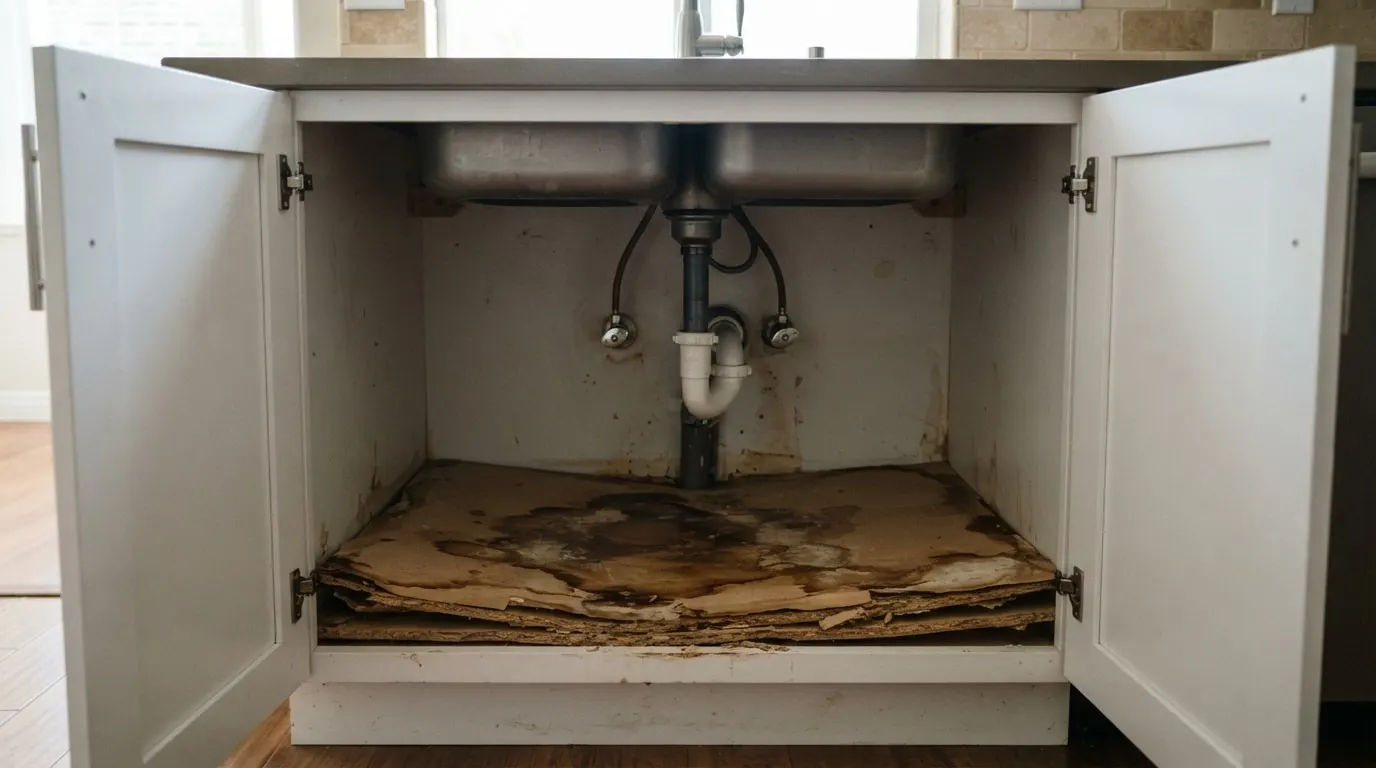
Kitchen cabinets and the sink base
A slow drip can run for months in the cabinet under the sink. The California Department of Public Health names leaks under kitchen and bathroom sinks as one of the less obvious signs of dampness in a home. By the time the cabinet floor is soft, water has usually run under the toe kick and into the floor and wall behind it.
Most cabinet boxes and sink-base floors are particleboard. FEMA’s flood guide warns that particleboard breaks down when it stays wet, and swollen particleboard doesn’t shrink back. Plywood boxes and solid wood face frames hold up better and can often be dried.
Drying a cabinet run means getting air into it. The doors open, the drawers come out, and the crew may pull the toe kick or open the back so air reaches the floor and wall underneath. On a slab, water under base cabinets can only leave by evaporating. How well that space dries usually tells you whether the cabinets can be kept. If the leak came from a supply line, a drain or the dishwasher hose, the burst pipe and supply line page covers the plumbing side.
Before anyone sands or refinishes
A wood floor sanded flat while it’s still wet will crown as it finishes drying over the next few weeks. Then it’s a replacement job.
So the finish work waits on the numbers. NWFA guidance sets the drying target within 2 percent of the floor’s normal moisture content, measured against dry boards elsewhere in the house. It also warns that a reading a restorer calls dry can still be too wet for a wood floor. EPA flood guidance puts the refinishing line at 15 percent or less on a moisture meter. It also says drying usually takes several days to weeks, and wet wall cavities shouldn’t be sealed or painted until they’re dry inside. You’ll have a written scope and price before work starts, and the drying log shows when each room got there.
Floor and drywall questions before anything gets pulled
Is luxury vinyl plank safe if it says waterproof?
The planks are, the floor under them often isn't. One major brand's warranty says its flooring isn't designed to handle water underneath it, only topical spills through sealed joints. Water that runs in at a wall or under a dishwasher still has to be found and dried.
Do the baseboards really have to come off?
Usually, yes, along the wet wall. With the baseboard off, the crew can read the bottom of the drywall and the sill plate and see whether water is sitting in the cavity. Solid wood base that reads dry later can often go back up.
Can the wet section be patched with new boards?
Often it can, when the damage stops at a few rows and the rest of the floor dries flat. Matching depends on species, board width and the age of the finish. The crew lead checks those before the scope is written.
How long before new flooring can go down on a wet slab?
Longer than the room feels. A slab under glue or sealer gives up water slowly, and new flooring goes down only after the concrete reads within the flooring and adhesive makers' limits.